Introduction
As blockchain systems continue evolving toward modular and multi-layered architectures, one challenge has become increasingly difficult to ignore: the growing burden placed on nodes responsible for storing and validating expanding amounts of state data.
Every decentralized network depends on validators being able to verify the correctness of transactions and maintain synchronized records of system activity. But as ecosystems scale, state storage requirements continue increasing. Rollups generate large volumes of execution data, decentralized applications maintain increasingly complex smart contract states, and interoperability systems introduce additional coordination layers.
This has led developers and researchers to revisit a fundamental question: should validators really need to store the entire state of the network in order to verify correctness?
That question is now driving renewed interest in stateless validation architectures. Rather than requiring validators to maintain complete historical state databases, these systems aim to verify transactions using compact cryptographic witnesses that prove correctness without relying on persistent full-state storage.
While the topic may appear deeply technical, its implications reach directly into the future scalability, decentralization, and accessibility of blockchain infrastructure. Stateless validation is increasingly being viewed not as a niche optimization but as a foundational efficiency layer for next-generation decentralized systems.
What Happened (Brief & Factual)
During early 2026, infrastructure discussions across Ethereum-aligned ecosystems and modular blockchain research communities increasingly focused on stateless validation mechanisms designed to reduce validator storage overhead.
Research efforts explored witness-based verification systems, state access proofs, and cryptographic commitment structures capable of allowing validators to verify blocks without storing complete network state locally.
The broader trend reflects growing concern that continuously expanding state requirements may eventually create decentralization pressures by increasing hardware demands for validator participation.
Background & Context
Traditional blockchain validation models rely heavily on stateful execution. Validators maintain a complete local copy of network state — including account balances, smart contract storage, and historical updates — in order to verify incoming transactions and produce new blocks.
This model works effectively at smaller scales, but it becomes increasingly resource-intensive as ecosystems expand. Every new decentralized application, token interaction, and contract update contributes to long-term state growth.
Over time, this creates several problems. Storage requirements increase. Node synchronization becomes slower. Validator hardware demands rise. Most importantly, the cost of independently participating in validation gradually increases as networks mature.
Earlier blockchain scaling discussions focused primarily on transaction throughput. However, infrastructure developers have increasingly realized that state growth itself represents a major scalability constraint.
Stateless validation architectures emerged as one response to this issue. Instead of assuming validators must store all state data permanently, these systems attempt to separate transaction verification from persistent local storage requirements.
This idea aligns naturally with modular blockchain philosophy, where responsibilities such as execution, settlement, data availability, and verification become increasingly specialized and optimized independently.
How This Works (Core Explanation)
In a stateless validation system, validators do not need to maintain complete copies of blockchain state locally in order to verify transactions.
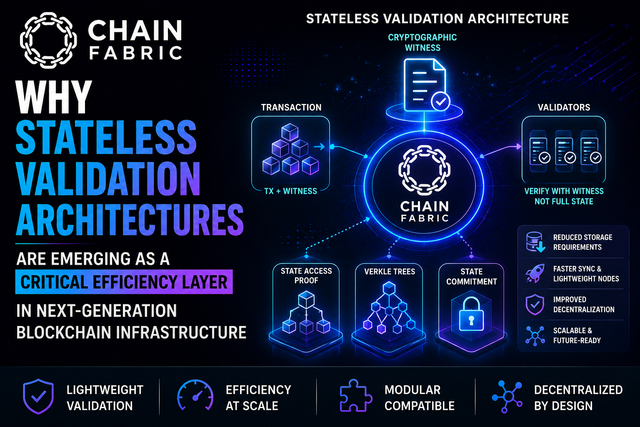
Instead, transactions are accompanied by cryptographic witnesses — compact proofs that provide all necessary information required to validate state transitions. These witnesses effectively prove that the transaction is interacting with valid portions of the blockchain state without requiring validators to independently store the entire database.
To understand the concept more intuitively, imagine a traditional validator as someone maintaining an enormous archive library locally at all times. Stateless validation changes the model by allowing validators to receive verified excerpts only when needed rather than storing every document permanently.
The system typically relies on cryptographic commitment structures such as Merkle trees or Verkle trees. These structures allow validators to confirm that specific pieces of state belong to the correct global state root without accessing the full database.
When a transaction is submitted, the associated witness contains proof paths demonstrating that relevant account balances or storage slots exist within the current state commitment. Validators verify the witness against the state root and confirm the transaction’s validity without independently maintaining all underlying state data.
Some architectures also separate state providers from validators entirely. Specialized nodes may maintain complete historical state databases, while lightweight validators focus exclusively on verification and consensus participation.
(Suggested internal link: “How Blockchain Consensus Mechanisms Work”)
Why This Matters for the Crypto Ecosystem
The implications of stateless validation extend far beyond storage optimization. At a structural level, these systems attempt to preserve validator accessibility as blockchain ecosystems become more complex and data-intensive.
For validators, reduced storage requirements lower hardware demands and synchronization overhead. This potentially makes participation more accessible to smaller operators rather than concentrating validation among large infrastructure providers.
Developers also benefit indirectly. More efficient validation systems improve scalability and reduce infrastructure friction as decentralized applications continue expanding.
Users may eventually experience faster synchronization, more responsive light clients, and broader participation in decentralized verification infrastructure.
Stateless architectures are particularly important for modular ecosystems. As rollups and interoperability layers generate increasingly fragmented state environments, reducing validator burden becomes essential for maintaining scalable coordination across many independent execution domains.
At a broader level, stateless validation reinforces one of blockchain infrastructure’s central goals: ensuring that verification remains decentralized and accessible even as systems scale globally.
Risks, Limitations, or Open Questions
Despite their potential benefits, stateless validation systems introduce significant technical complexity.
One major challenge involves witness size management. While validators store less data locally, transactions themselves may become larger because they must include additional proof information. Efficient witness compression therefore becomes critically important.
There are also concerns around network bandwidth. Frequent transmission of witnesses may increase communication overhead between nodes, particularly during periods of high activity.
Another open question involves state availability. If validators rely on external state providers, ensuring reliable and censorship-resistant access to witness data becomes essential.
Migration complexity also presents challenges. Existing blockchain systems were not originally designed around stateless assumptions, meaning transitioning toward witness-based validation may require substantial protocol redesign and infrastructure upgrades.
Finally, cryptographic commitment systems themselves remain active areas of research. Advanced structures such as Verkle trees offer efficiency improvements but introduce additional implementation and verification complexity.
Broader Industry Implications
The growing focus on stateless validation reflects a deeper evolution in blockchain scalability priorities.
Early infrastructure discussions concentrated heavily on increasing transaction throughput. More recent architectural debates increasingly focus on sustainability — specifically how decentralized systems can continue scaling without gradually excluding smaller participants from validation infrastructure.
This shift signals that scalability is no longer viewed purely as an execution problem. It is increasingly understood as a coordination and accessibility challenge involving storage, verification, synchronization, and trust distribution simultaneously.
Stateless validation also aligns with broader trends toward infrastructure specialization. As modular blockchain systems mature, distinct layers increasingly optimize independently for execution, settlement, sequencing, verification, and state access.
In the long term, stateless architectures may become essential for enabling lightweight decentralized participation across increasingly global and modular blockchain ecosystems. Their importance lies not only in reducing hardware costs but also in preserving the practical decentralization of validation itself.
FAQ
1. What is stateless validation?
Stateless validation is a blockchain verification model where validators verify transactions using cryptographic witnesses rather than storing the entire network state locally.
2. Why is blockchain state growth a problem?
As networks grow, storing complete state databases becomes increasingly resource-intensive, potentially raising hardware requirements and reducing validator accessibility.
3. What are witnesses in stateless systems?
Witnesses are compact cryptographic proofs included with transactions that allow validators to confirm correctness without maintaining full state storage.
4. Does stateless validation reduce security?
Not necessarily. Properly designed witness systems preserve cryptographic verification guarantees while reducing local storage requirements for validators.
5. Why is this important for modular blockchain ecosystems?
Modular systems generate increasingly fragmented and large-scale state environments. Stateless validation helps manage verification efficiency as these ecosystems expand.
Conclusion
Stateless validation architectures are emerging as a critical efficiency layer in the evolution of scalable blockchain infrastructure. As decentralized ecosystems grow more modular and data-intensive, reducing validator storage burden is becoming increasingly important for maintaining accessibility and decentralization.
By separating verification from persistent state storage, stateless systems attempt to preserve lightweight participation without sacrificing cryptographic correctness. Their significance lies not only in improving scalability but also in protecting the long-term sustainability of decentralized validation itself.
As blockchain infrastructure continues evolving toward specialized modular architectures, stateless verification may ultimately become one of the defining coordination primitives supporting scalable and accessible decentralized systems.
Disclaimer: This article is for educational purposes only and does not constitute financial or investment advice.


0 Comments