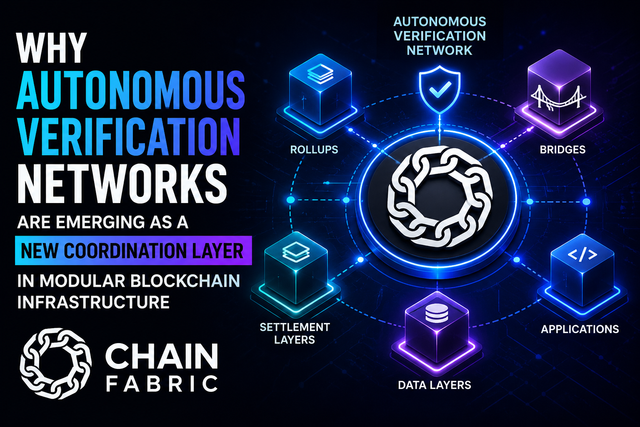
Why Autonomous Verification Networks Are Emerging as a New Coordination Layer in Modular Blockchain Infrastructure
As of 14 May 2026
Introduction
For years, blockchain scalability discussions revolved around a relatively simple question: how can decentralized systems process more transactions without sacrificing security? Rollups, modular execution environments, and data availability layers gradually reshaped the answer. Yet as the architecture of crypto systems became more distributed, another challenge quietly emerged in parallel — how to verify increasingly fragmented activity efficiently across multiple layers.
This challenge is now giving rise to a new category of infrastructure often described as autonomous verification networks. These systems are designed to independently verify proofs, state transitions, and cross-chain activity across modular blockchain ecosystems without relying on any single execution layer. In many ways, they represent the next stage in the evolution of decentralized trust coordination.
While they may not attract the same public attention as new tokens or trading narratives, verification networks are becoming increasingly important behind the scenes. As modular blockchain ecosystems continue expanding, the ability to coordinate and validate information across many independent environments may become one of the defining infrastructure requirements of the next generation of crypto systems.
What Happened (Brief & Factual)
Throughout early 2026, infrastructure developers and rollup ecosystems accelerated work around decentralized verification coordination systems capable of validating proofs and state commitments across multiple chains and execution layers. These networks are increasingly being positioned as independent verification infrastructure rather than extensions of any single blockchain.
The broader trend reflects growing recognition that verification itself is becoming a specialized layer within modular crypto architecture, particularly as the number of rollups, interoperability systems, and zero-knowledge applications continues increasing.
Background & Context
In early blockchain systems, verification was relatively straightforward because all activity occurred within a single chain environment. Every validator processed the same transactions and maintained the same state history. As a result, trust coordination was tightly coupled with consensus itself.
Modular blockchain design fundamentally changed this model. Rollups execute transactions independently. Data availability layers store transaction data separately. Settlement layers finalize proofs asynchronously. Cross-chain bridges move assets and information between distinct environments. While this architecture improves scalability and specialization, it also fragments verification responsibilities.
Initially, most ecosystems handled verification internally. Rollups verified their own proofs, bridges maintained custom validation logic, and applications often relied on isolated trust assumptions. However, as modular ecosystems expanded, this approach became increasingly inefficient and difficult to coordinate.
Developers began exploring whether verification itself should become a dedicated infrastructure layer — one capable of independently validating proofs and coordinating trust signals across many execution environments. This idea gradually evolved into the concept of autonomous verification networks.
These systems do not replace settlement layers or consensus mechanisms. Instead, they operate as specialized coordination infrastructure focused on validating correctness and propagating trustworthy verification results throughout modular ecosystems.
How This Works (Core Explanation)
Autonomous verification networks function by independently validating cryptographic proofs, state commitments, or execution claims generated by external systems such as rollups or interoperability protocols.
When a rollup processes transactions, it may generate a validity proof confirming that its state transitions are correct. Traditionally, that proof would be submitted directly to a settlement layer for verification. In an autonomous verification model, however, independent verifier networks can first validate the proof before propagating attested results to other systems.
These networks typically consist of distributed verifier nodes responsible for checking cryptographic correctness and maintaining synchronized verification records. Because verification tasks can often be parallelized, networks are able to specialize specifically in proof validation efficiency rather than transaction execution.
Some designs also incorporate recursive verification architectures, where multiple proofs are aggregated into compressed representations before final attestation occurs. This reduces overhead while allowing verification coordination across many independent rollups or execution layers simultaneously.
Importantly, autonomous verification networks are increasingly being explored as reusable infrastructure. Instead of each rollup building isolated verifier systems, multiple ecosystems can potentially rely on shared verification layers that provide consistent trust coordination and interoperability guarantees.
(Suggested internal link: “How Blockchain Consensus Mechanisms Work”)
Why This Matters for the Crypto Ecosystem
The rise of autonomous verification networks has implications that extend far beyond cryptographic optimization. At a structural level, these systems represent an attempt to modularize trust coordination itself.
For developers, shared verification infrastructure reduces duplication. Rather than maintaining isolated verification pipelines for every rollup or application, ecosystems can rely on coordinated verifier networks that improve efficiency and interoperability.
Users may benefit indirectly through faster proof processing, lower settlement costs, and more seamless interaction between modular blockchain environments. As ecosystems become increasingly multi-chain and rollup-centric, verification coordination plays a growing role in overall user experience.
Infrastructure providers also gain flexibility. Specialized verifier networks can optimize specifically for proof validation throughput and recursive aggregation efficiency, enabling settlement layers to focus on finality and consensus rather than processing large volumes of independent verification tasks.
At the ecosystem level, autonomous verification infrastructure strengthens the scalability of modular systems. Without efficient verification coordination, the growth of rollups and cross-chain systems risks overwhelming settlement layers with fragmented proof workloads.
Risks, Limitations, or Open Questions
Despite their potential advantages, autonomous verification networks introduce important design challenges. One concern involves centralization risk. If a small number of verifier operators dominate the network, trust coordination could become concentrated even if execution remains decentralized elsewhere.
There are also questions around incentive alignment. Verifier nodes must be economically motivated to validate proofs honestly and consistently. Designing robust slashing or reputation systems without introducing excessive complexity remains an ongoing challenge.
Interoperability is another unresolved issue. Different ecosystems use varying proof systems and verification standards, making universal coordination difficult. Achieving broad compatibility may require shared cryptographic frameworks or standardized attestation formats.
Latency considerations also matter. While verifier networks can improve long-term scalability, additional verification layers may introduce extra coordination steps before final settlement occurs.
Finally, governance questions remain open. Determining how verification networks evolve, upgrade cryptographic systems, or manage dispute resolution introduces another layer of decentralized coordination complexity.
Broader Industry Implications
The emergence of autonomous verification networks reflects a broader transition in blockchain architecture from monolithic trust systems toward specialized trust coordination layers.
Earlier blockchain models assumed that consensus, execution, and verification were inseparable functions. Modern modular systems increasingly treat these responsibilities independently. Execution happens on rollups. Data availability exists elsewhere. Settlement occurs asynchronously. Verification is now becoming its own dedicated optimization domain.
This shift mirrors patterns seen in other large-scale distributed systems, where specialized infrastructure layers emerge over time to handle coordination complexity more efficiently. Verification networks may eventually become as foundational to modular crypto ecosystems as content delivery networks became to the modern internet.
Over the long term, the ability to independently coordinate trust across many execution environments may become essential for sustaining scalable decentralized ecosystems. In that sense, autonomous verification infrastructure is not merely a technical optimization — it represents a deeper evolution in how blockchain systems organize and distribute trust itself.
FAQ
1. What are autonomous verification networks?
They are distributed infrastructure systems designed to independently validate cryptographic proofs, state transitions, or execution claims across modular blockchain ecosystems.
2. Why are these networks becoming important?
As rollups and modular architectures expand, verification workloads become fragmented. Dedicated verifier networks help coordinate proof validation more efficiently.
3. Do verification networks replace consensus?
No. Consensus layers still finalize transactions and secure settlement. Verification networks focus specifically on validating correctness and propagating trusted attestations.
4. How do these systems improve scalability?
By specializing in proof verification and aggregation, they reduce overhead on settlement layers and enable modular ecosystems to process larger volumes of activity more efficiently.
5. Are there risks associated with autonomous verification networks?
Yes. Potential concerns include verifier centralization, interoperability challenges, governance complexity, and economic incentive alignment.
Conclusion
Autonomous verification networks are emerging as a foundational coordination layer within the rapidly evolving modular blockchain landscape. As execution, settlement, and data availability continue separating into specialized layers, verification itself is becoming an increasingly important infrastructure domain.
The significance of this shift lies not only in efficiency gains but also in how decentralized systems distribute and coordinate trust across fragmented ecosystems. Verification is no longer just a background process tied to consensus; it is evolving into reusable, scalable infrastructure in its own right.
As modular architectures mature, the ability to independently validate and coordinate correctness across many execution environments may become one of the defining capabilities of next-generation blockchain systems.
Disclaimer: This article is for educational purposes only and does not constitute financial or investment advice.


0 Comments